
Search engine optimization (SEO) is undergoing a radical transformation. The era of mechanically collecting keywords and mindlessly inserting them into text (“keyword stuffing”) is finally over.
Today, search engines are powered by highly sophisticated neural network models that evaluate context, hidden user intent, and the added value of content. In the era of Google’s smart answers (AI Overviews) and declining organic CTR due to Zero-Click search results, the classic approach to semantics no longer works.

Today, Keyword Research is a complete process of semantic architecture for a digital business. To build a strong website structure and outperform competitors, you need the right technology stack.
Trying to buy every tool available is pointless. The main secret of modern Keyword Research is not using one “perfect” piece of software, but building the right combination of tools for your specific tasks.
The Optimal Setup: A Professional Starter Stack
For most projects — from content blogs to large SaaS products and local e-commerce — the ideal workflow looks like this:
- Market Analysis: Similarweb — for analyzing the niche and competitors’ traffic.
- SEO Platforms: Ahrefs or SE Ranking — for competitive research and extracting competitor keywords.
- Keyword Research: KeywordStat — for keyword research and clustering.
- NLP Editors: Wrytix and Surfer SEO — for content creation and NLP optimization.
Market Analysis: Similarweb
This tool is used at the very beginning for global niche and traffic analysis. It shows where competitors get their actual visitors from, which channels perform best for them, and whether it makes sense to enter the market at all.
SEO Platforms: Ahrefs or SE Ranking
The heavy artillery required for competitive intelligence. With these tools, you can extract the keywords your direct competitors already rank for in the Top 10 and discover phrases you are missing.
Keyword Research: KeywordStat
SEO tool for keyword research and clustering. You enter a seed keyword, and the service expands it using live search suggestions and automatically groups thousands of phrases into ready-to-use landing pages based on search result similarity.
NLP Editors: Wrytix and Surfer SEO
Tools for content creation and textual NLP optimization. Surfer analyzes competitors and builds a content brief based on keyword density, while Wrytix AI Writer Helper generates expert content strictly according to that brief, optimizing it for AI answer blocks.
Each class of SEO software has its own strengths and hidden drawbacks that are rarely mentioned in marketing materials. To invest effectively in your stack, you need to understand the specifics of each type of tool.
Universal SEO Platforms
This category includes giants such as Ahrefs, Semrush, SE Ranking, Serpstat, and Ubersuggest.
They have enormous historical databases of keywords and backlinks. They allow you to manage a project comprehensively from a single dashboard: track rankings, find technical code issues, and analyze competitors’ link-building strategies. Metrics such as Traffic Potential in Ahrefs provide a realistic understanding of the traffic volume of an entire topic.
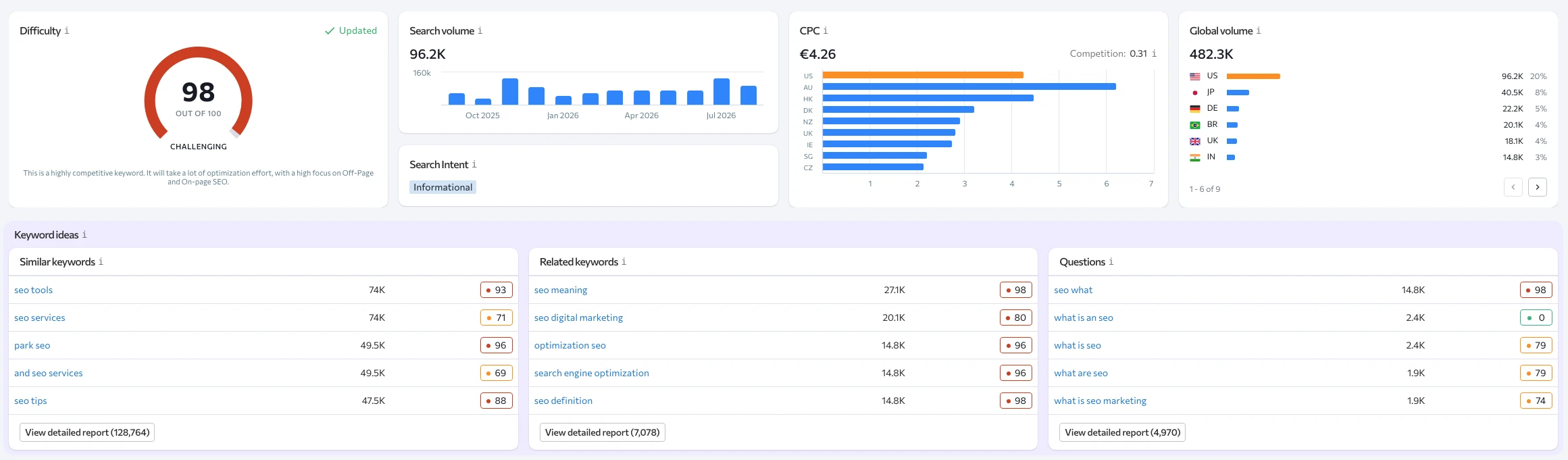
Flagship platforms are expensive, typically costing $100–$130 per month, and have strict export limits. Their search suggestion databases are updated cyclically, so they often miss “hot” micro-trends and new conversational queries.
Tools for Collecting Search Suggestions and Long-Tail Keywords
This category includes specialized services such as KeywordStat, KeywordTool.io, and KWFinder.
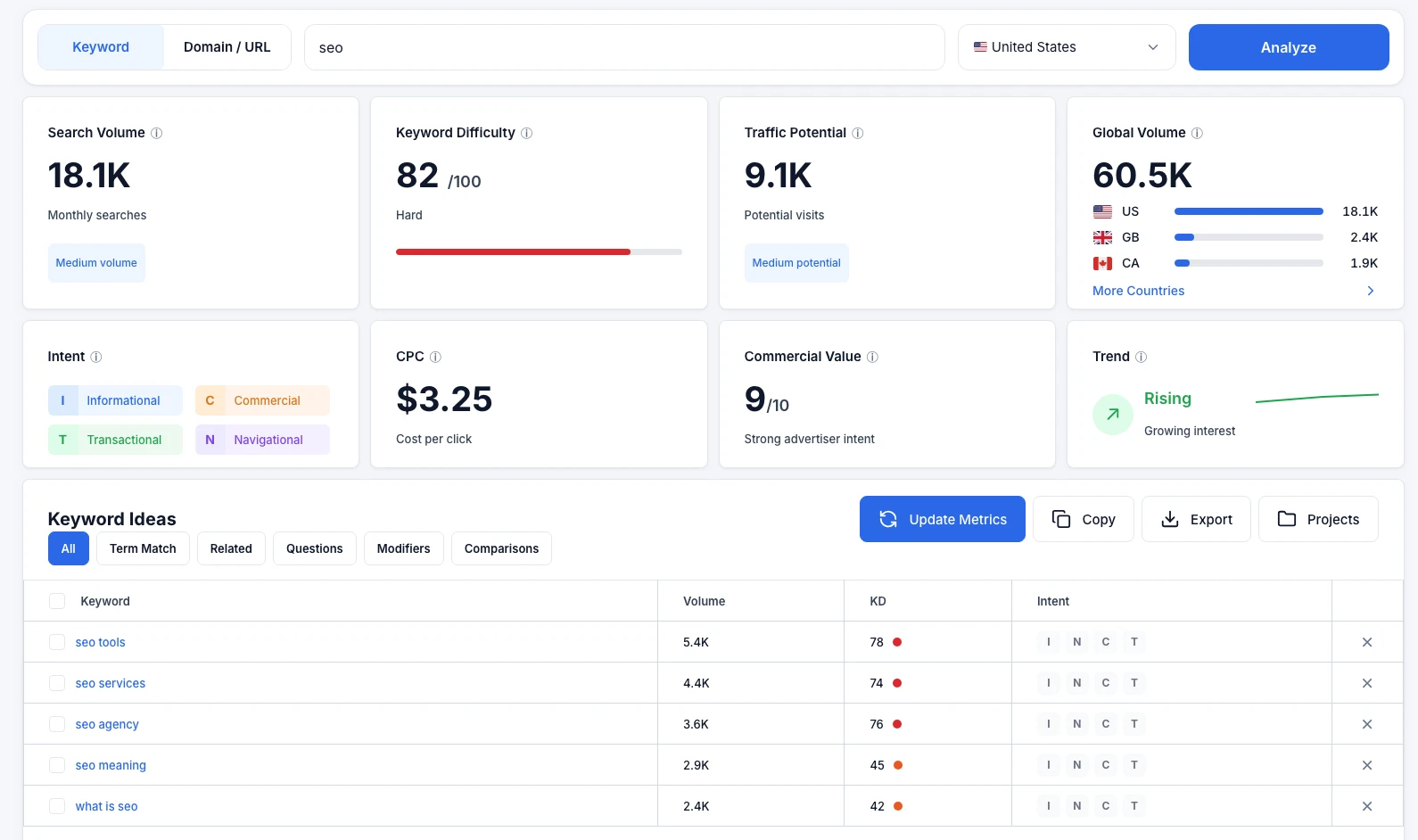
These tools collect the freshest “tail” of low-volume queries directly from search suggestion APIs. This is where the most conversion-oriented audience is hidden. KeywordStat saves weeks of manual work thanks to built-in automatic clustering algorithms based on live search results. KeywordTool.io is indispensable if your business is looking for customers outside Google — on YouTube, Amazon, the App Store, or TikTok.
They are not designed for backlink analysis or technical audits. They are specialized tools for designing semantic architecture and page structures.
Question Research Tools
The leaders in this niche are AnswerThePublic, AlsoAsked, and AnswerSocrates.
These are indispensable assistants for content marketers and blog authors. AlsoAsked parses People Also Ask blocks in real time and builds an interactive map of nested questions. This provides a ready-made structure for the subheadings of future content.
The free limits of these tools run out after just a few searches. They provide lists of phrases without deep SEO metrics such as search volume and CPC, so the data requires further filtering through more comprehensive SEO platforms.
Low-Competition Tools
This category includes LowFruits, KeySearch, and Keyword Chef.
They help young websites with low authority find opportunities in the search results. They automatically identify queries where weak forums such as Reddit and Quora or abandoned blogs rank in the Top 3. This makes it possible to generate organic traffic without purchasing expensive backlinks.
Most of these services were created by Western developers and are primarily optimized for Western markets. Their processing speed for large databases is lower than that of the heavier SEO platforms.
Textual NLP Editors (Content & SERP Tools)
This category is represented by Surfer SEO, Wrytix, and Clearscope.
They analyze content density and semantic entities used by top-ranking competitors. These services help ensure that your content is highly relevant to search algorithms. Wrytix additionally automates content creation, generating concise answers designed for direct inclusion in Google AI summaries.
The main disadvantage is the high cost of auditing each individual document. Text generated or optimized by a machine always requires final human editing to remain natural and engaging.
Browser Extensions
This category includes extensions such as Keywords Everywhere, Keyword Surfer, and SEOquake.
They are available for free or at minimal cost. Extensions pull search volume metrics, CPC, and competitor domain parameters directly into the Google search results interface during normal browsing. This is an ideal solution for quickly analyzing individual ideas on the fly.
They are suitable only for a superficial evaluation of individual queries. It is physically impossible to collect, clean, and cluster a semantic core containing several thousand queries using a browser extension.
Practical Selection: Which Tool Is Best for Which Task?
Trying to use one tool for every stage of the process is the main reason for inflated budgets and ineffective SEO. To optimize costs and achieve maximum results, software should be selected according to the current objective and stage of development of your digital project.
Market Analysis, Competitor Budget Estimation, and Initial Research
If you are launching a new product, planning to expand into another region, or want to understand how your direct competitors survive, you need deep marketing analytics. You need to know their customer acquisition channels and traffic volumes.
Ideal stack: Similarweb + Ahrefs (or an alternative)
How it works: Similarweb provides a high-level understanding of the market: what market share competitors have, what portion of their traffic comes from search, and what portion comes from social media. Then you connect the heavy SEO platforms to study their organic keyword portfolio and paid advertising campaigns in Google Ads in detail.
Designing a New E-commerce, Service, or SaaS Website Structure From Scratch
Once the niche has been selected, the next stage is creating the semantic framework. Here, it is important to collect all possible search suggestions and group them so that keyword cannibalization does not occur on the website and each page is responsible for its own specific intent.
Ideal stack: SE Ranking (or Serpstat) + KeywordStat
How it works: From the universal platforms, you export seed terms and the basic keywords used by competitors. Then the entire dataset is uploaded to KeywordStat.
The tool massively scrapes live search suggestions, expands the semantic core to the maximum, automatically removes irrelevant data using N-grams, and performs automatic clustering.
As a result, you get a ready-made website page map.
Finding Easy Topics for an Informational Blog to Generate Fast Traffic Without Links
If you have a young content website, informational project, or corporate blog without a powerful backlink profile, your goal is to find opportunities in the search results. You need topics that are in demand among the audience but ignored by large authoritative media outlets.
Ideal stack: AlsoAsked + LowFruits
How it works: AlsoAsked finds real chains of user questions and audience pain points, creating a pool of topics. This list is then uploaded to LowFruits.
The service analyzes the search results and highlights queries where weak forums or outdated websites rank in the Top 3. You get a list of topics that can reach the Top positions through high-quality content alone.
Large-Scale Content Creation and Optimization for AI Answer Requirements
Once the website structure or blog content plan has been approved, it is time to move on to content production. In today’s environment, content must not only be readable — it also needs to be NLP-optimized for search crawlers and concise enough to appear in AI Overviews.
Ideal stack: Surfer SEO + Wrytix
How it works: Surfer SEO analyzes the Top 3 competitors and builds a precise content brief: LSI keyword density, article length, and number of headings.
You then transfer these parameters to Wrytix. The specialized AI assistant generates expert content strictly within the specified NLP limits while also creating concise factual answers designed for direct citation by search engines.
Conclusion
Modern Keyword Research is no longer a routine process of collecting phrases in Excel. Today, it is a high-tech process of designing the digital architecture of a business.
There is no single universal service on the market that performs all tasks equally well.
The winners are those who know how to build an individual, flexible technology stack:
- Similarweb for market intelligence;
- Ahrefs or SE Ranking for competitor analysis;
- KeywordStat for automating search suggestion clustering;
- Surfer SEO and Wrytix for creating next-generation content.
This approach saves hundreds of hours of manual work, protects against wasted budgets, and provides a stable flow of organic traffic.