
Forty domains are sitting in a prospecting sheet. One has a DA of 52, a DR of 18, and almost no visible search traffic. Another has weaker headline scores, yet its referring domains are relevant and its archive history looks clean.
Which one deserves the next ten minutes?
That is the trap. A domain authority score feels like an answer because it turns a messy backlink profile into one tidy number. In practice, the number is a screening signal. The decision still comes from the evidence behind it.
I use authority metrics to sort a list, spot odd cases, and decide where to look next. I never use a single score to approve a guest-post site, buy an expired domain, or judge a competitor.
People often say “domain authority” as if every SEO platform calculates the same thing. They do not. Moz has Domain Authority (DA), Ahrefs has Domain Rating (DR), and Semrush has Authority Score (AS). Each vendor uses its own data, formula, and update cycle.
None of these scores is a Google ranking factor. Google does not read a Moz or Ahrefs score and assign rankings from it. The scores are third-party estimates designed for relative comparison: site A versus site B, or one prospect against the rest of a similar list.
This distinction matters because a score can be useful without being literal. A thermometer is useful because it reports one condition. It does not explain the entire patient.
DA runs from 0 to 100 and estimates a domain’s relative ability to rank based largely on link data. It works best as a comparison inside a peer set. A DA 35 local accounting site and a DA 35 global news site are not equivalent link opportunities.
DA is familiar and easy to communicate, which is why outreach teams use it so often. Its weakness is the same as any broad site-level score: it can hide weak pages, irrelevant links, traffic loss, and a messy ownership history.
Ahrefs Domain Rating (DR) and URL Rating (UR)
DR is a 0–100 measure of backlink profile strength at the domain level. It looks at the quality and quantity of referring domains and accounts for how many other sites those referring domains link to. UR applies a similar idea at the page level.
That page-level check matters. A strong DR does not guarantee that the page carrying your link has any link equity, meaning ranking power passed through links. A buried contributor page with no internal links may be a weak placement on a strong domain.
Authority Score combines link power with estimated organic traffic and signals associated with manipulation. This wider input set can catch situations that a link-only score misses, although it remains a comparative third-party metric.
Referring domains, backlinks, Spam Score, and Open PageRank
Raw backlink count is often the noisiest number on the screen. One sitewide footer link can create thousands of backlinks from a single website. Referring domains count the unique websites that link in, so the figure is usually more useful for a first pass.
Moz Spam Score flags patterns often found on penalized or low-quality sites. It is a warning system, not proof of a penalty. Open PageRank is an independent PageRank-style score that offers another view of link prominence. I treat both as supporting signals.
Karma Domain Metric (KDM)
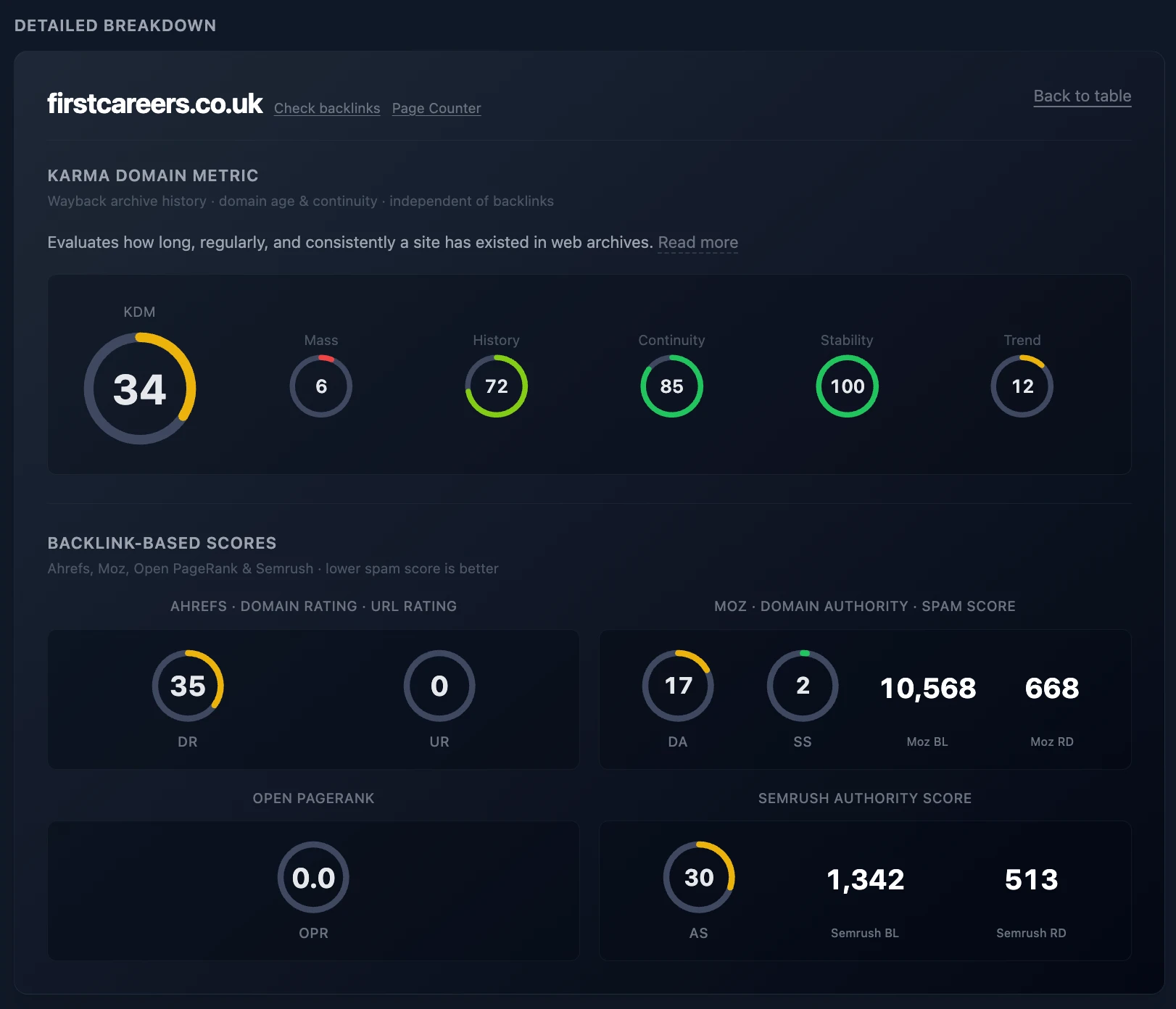
KDM looks in a different direction. It measures the depth, continuity, stability, and trend of a domain’s archived history in the Wayback Machine. Because it is independent of backlinks, it can expose a domain that looks strong in a link index but has a thin, broken, or recently repurposed web history.
This is especially relevant for expired domains. A backlink score describes what points to the domain. Archive history helps explain what the domain used to be.
Why disagreements between metrics are useful
Beginners often worry when DA, DR, and AS disagree. I prefer disagreement. It creates a question worth investigating.
- High DA with much lower DR may point to different link indexes, older signals, or a profile whose strength is concentrated in places one provider sees differently.
- High DR with very few referring domains can mean that a small number of strong sites carry most of the score. Losing one link could change the picture quickly.
- Strong authority scores with little estimated traffic may reflect ranking losses, poor topical fit, deindexing, or a link profile that never produced search visibility.
- Good link metrics with weak archive continuity can indicate ownership changes, parked periods, redirects, or a complete topic switch.
- A respectable domain score with a weak target page often means the placement will receive little internal support.
The mismatch is the lead. The next check should explain it.
My five-pass workflow for checking a domain
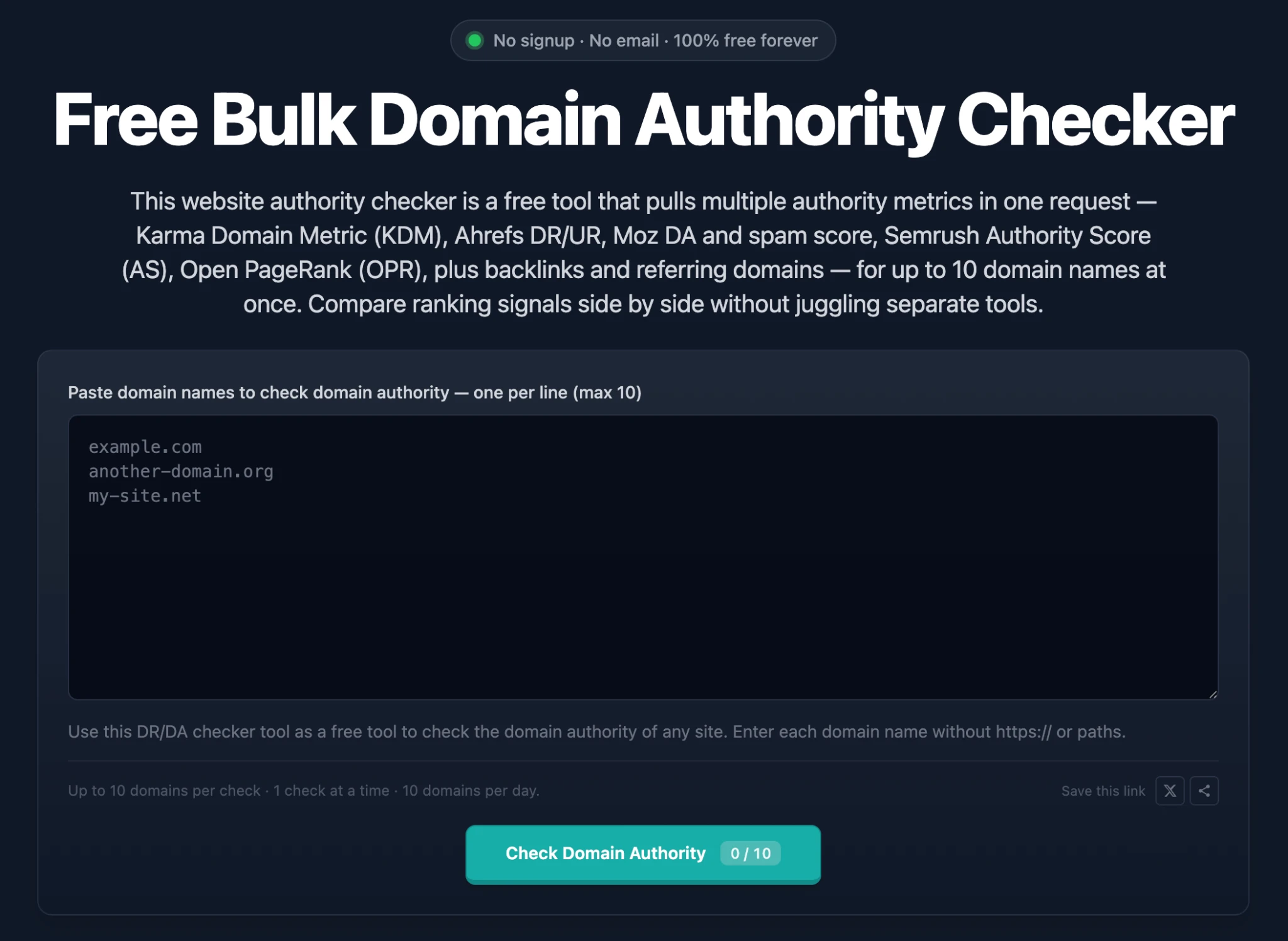
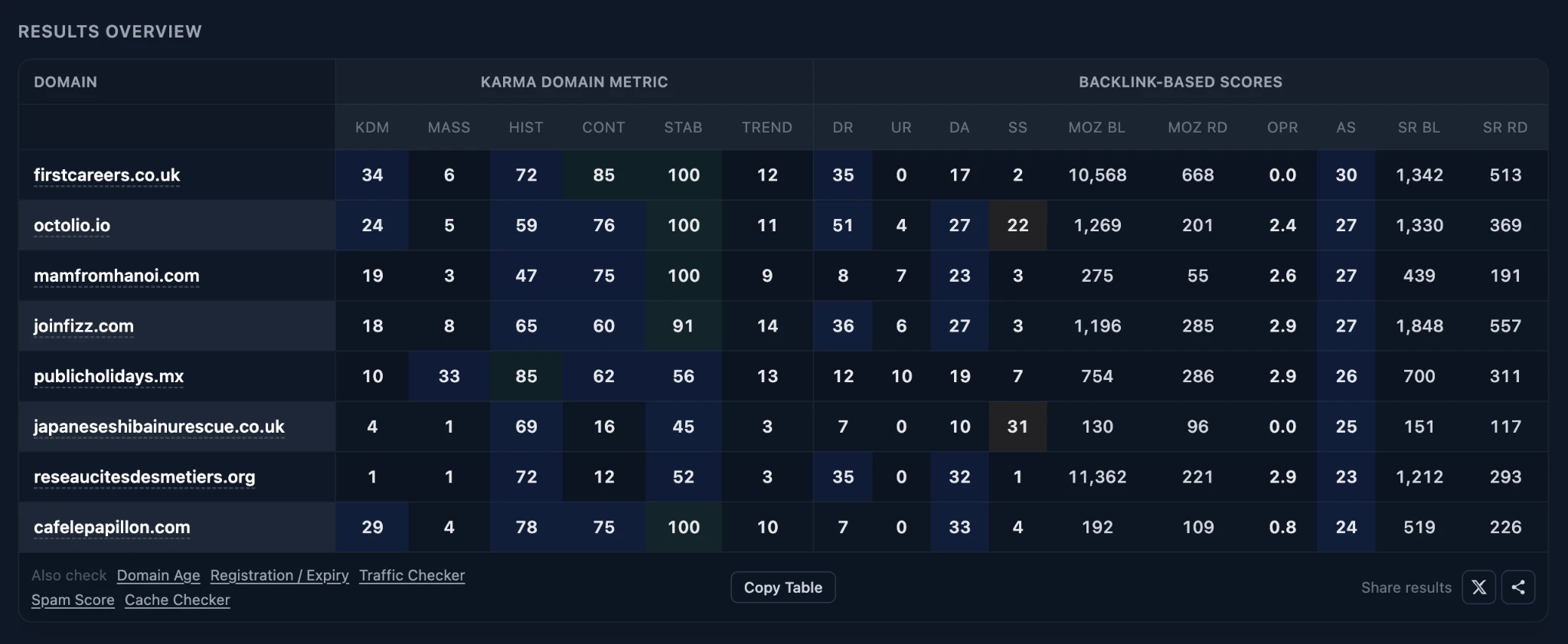
For a small working batch, I start with the free bulk Domain Authority Checker. It puts KDM, Ahrefs DR and UR, Moz DA and Spam Score, Semrush Authority Score, referring domains, backlinks, and Open PageRank in one comparison view. Seeing the metrics side by side makes outliers obvious before I open several separate reports.
Pass 1: Confirm topical relevance
I start with the domain itself, its current pages, and its historical topic. Topical relevance is the relationship between the site’s subject and the page I want to rank. A lower-authority cybersecurity site can be a better link source for security software than a higher-authority lifestyle blog.
For outreach, I read the home page, several recent posts, the author pages, and the categories. For an expired domain, I also review multiple archived snapshots. One clean screenshot is not enough to establish a stable history.
Pass 2: Compare the score spread
I do not average DA, DR, AS, and KDM. They are different measurements, so an average would create a number with no clear meaning. I look at the spread instead.
If the scores sit in roughly the same band, I move on. If one score is far above or below the others, I write down the discrepancy and make the next checks answer it.
Pass 3: Inspect referring domains before backlink totals
I look for diversity, relevance, and concentration. Diversity means the links come from many independent sites. Concentration means a few sites or sitewide links account for a large share of the profile.
Then I sample actual linking pages. Are they indexed? Are they editorial links inside useful content? Do the pages have outbound-link lists that look sold at scale? Metrics can prioritize this review, but the pages decide it.
Pass 4: Check risk and historical continuity
Spam Score can point me toward a risky pattern. Archive history gives the pattern context. I look for long parked periods, sudden language changes, casino or pharma content, doorway pages, mass-generated posts, and ownership switches followed by an unrelated rebuild.
A topic change is not automatically fatal. The question is whether the old links still make sense for the new use. If most links were earned by a regional newspaper and the domain now hosts a crypto coupon site, the authority score may survive while the original reason for those links has disappeared.
Pass 5: Finish at the page level
For a live link prospect, I check the proposed page or the section where a new article would live. UR, internal links, crawl depth, indexation, and the page’s own traffic matter here. Crawl depth is the number of clicks needed to reach a page from the home page.
A domain-wide score cannot tell me whether an editor will bury the article, remove it after six months, add a nofollow attribute, or place it on an orphan page. Those are placement questions, and they need placement-level checks.
How the workflow changes by use case
Guest-post and digital PR prospecting
I use authority metrics as an early filter, then weight relevance, real readership, editorial standards, and the quality of recent outbound links. A site that publishes unrelated paid posts every day may pass a DA threshold and still be a poor long-term citation.
Competitor link research
When several competitors earn links from the same domain, that domain moves up my list. This is a link intersection: a site linking to two or more competitors but not to mine. Authority metrics help order the opportunities; the repeated competitor links show that the source is active in the niche.
Expired and auction domain screening
The cost of a false positive is higher here because money changes hands. After the first metric screen, I use Karma.Domains for expired domains to inspect archived content, anchor text, backlinks, topic changes, and signs of spam before considering a bid or registration.
I also check whether valuable links point to pages that can be rebuilt or redirected sensibly. Buying a domain with strong links to dead URLs and no matching content plan can waste most of the apparent equity.
Agency triage and recurring reports
Agencies need repeatable rules because different analysts will review the same kinds of lists. I define a shortlist rule, a manual-review rule, and a rejection rule. Metrics can trigger those lanes, while a human makes the final call on relevance and risk.
For larger workflows, the Karma.Domains Expired Domains API and MCP can feed the same checks into an internal tool, spreadsheet process, ChatGPT, or Claude. MCP, or Model Context Protocol, lets an AI assistant call a connected data service instead of relying on pasted screenshots or remembered figures.
A beginner-friendly decision rule
If you are new to link evaluation, keep the first version of the process simple:
- Reject obvious topic mismatches before spending time on metrics.
- Use DA, DR, or AS to compare domains in the same niche and of a similar type.
- Check referring domains and sample the actual linking pages.
- Investigate large disagreements between scores.
- Review spam signals and archive history before paying for a placement or domain.
- Check the specific page and placement conditions before approving the link.
This process is useful for new SEO specialists, freelance link builders, outreach teams, agency analysts, affiliate marketers, and anyone buying expired domains. The thresholds will differ, but the order of operations holds up.
The rule I keep on the spreadsheet
Authority scores tell me where to look. Relevance, real linking pages, search visibility, and historical continuity tell me whether a domain deserves trust, budget, or outreach.
When a metric looks unusually good, I do not celebrate it. I try to explain it.